The product changes every season, the photography carries the brand, and the same catalogue has to work for someone who knows exactly what they want and someone who is just browsing. Most templates pick one of those and fail the other. These two stores run on the same theme code; everything that differs between them is brand, copy and preset. The design system does the heavy lifting, and the shop that sits on top can be as big or as small as the business.
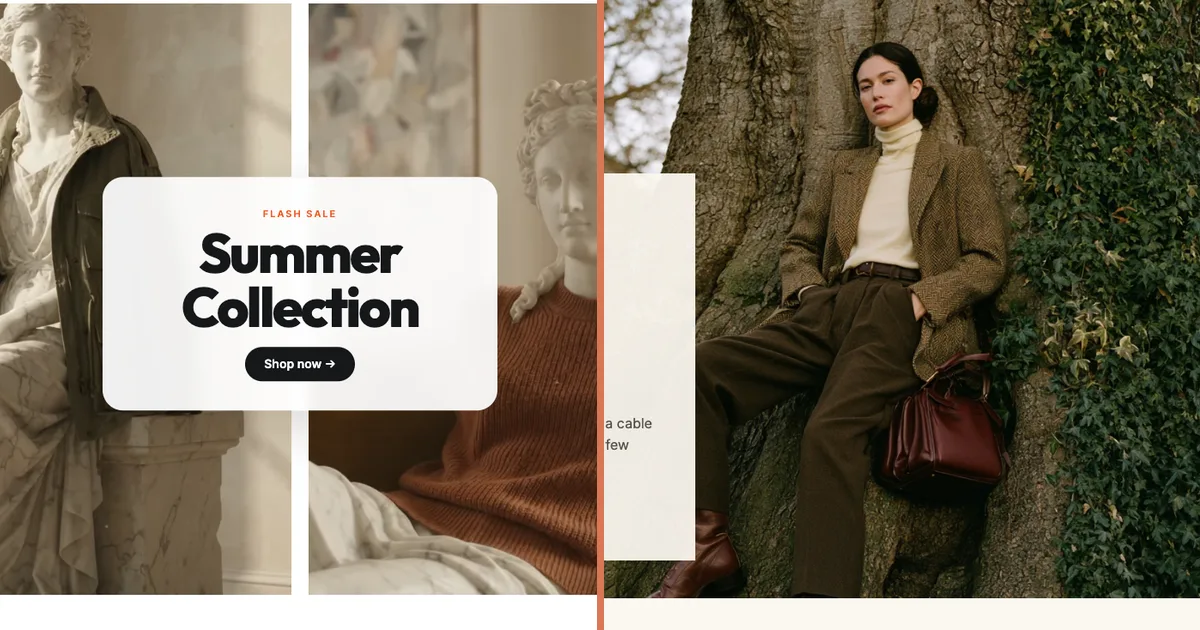
Both are on the examples page, with a live catalogue, bag and checkout you can walk through.
MarbleArc: built for range
MarbleArc is the department-store preset. It is designed for the businesses where the catalogue is the brand: department stores, fast fashion, multi-brand retailers, anyone with Women, Men, Kids and Accessories running side by side and hundreds or thousands of lines underneath.
The branding is deliberately impersonal. There is no founder story on the home page and no “our values” section; the wordmark is clean, the palette is neutral, and the photography does the talking. That is a choice, not an omission. When you sell twelve brands across four departments, the store’s own personality has to get out of the way so each product can have its own.
What it does instead is impact and throughput:
- A full-bleed hero and a departments mosaic on the home page, so the first screen says “everything is here” rather than “here is one thing”.
- Mega menus for every department, built from the collections in the catalogue. Add a sub-category and the menu picks it up.
- Category masonry grids at every level, with the same spacing from the top-level Women page down to Knitwear, so a 400-product department never feels like a list.
- Live 3D in the masonry. Accessories carries a bag you can turn with a drag and open full-screen. The model is an original built in code (no licensing), loaded with meshopt compression so it costs about as much as a large JPEG.
- Faceted category pages, pretty URLs down to colour and size, a lookbook with shoppable pins, a journal and a newsletter, all driven by the catalogue rather than hand-built.
For a fast-fashion operation the useful property is that the design never needs touching when the range changes. New drop, new department, new sale: it is all catalogue work, and the theme re-lays itself.
Honeystone: built for a label
Honeystone is the same theme switched to the boutique preset. It is a country-clothing label from Cheltenham, with one department, around twenty-five pieces, and a shop you can collect from.
Here the branding is everything. The home page opens on one landscape image with a card over it, then a single edit of pieces the brand has chosen, then the story with two photographs, then the lookbook and the journal. The about page has the shop’s address, the collection note and the posting note, because for a shop this size those are the trust signals.
The differences from MarbleArc, in practice:
- No mega menus. A flat nav: Shop, Coats & Jackets, Knitwear, Boots, Lookbook, Journal, About.
- One edit, not a mosaic. The brand names the pieces; the theme fills any gaps with the newest.
- Its own typeface and palette (Fraunces on honey and stone), its own photography set, its own copy, all held in one brand file.
- Collect from the shop as a delivery option at checkout, pointing to a real pickup location.
- The same category masonry, with the same 3D tote in it, because a small label still deserves the high-impact moments.
The theme code is shared. Fix a bug in the product page or improve the checkout and both stores get it. For an agency running several fashion clients, or a group with a flagship and a diffusion line, that is the model: one theme, many installs, each with its own catalogue, keys and brand.
How the two are actually built
Each store is a folder of short stubs that point at the shared theme, plus one brand file that sets:
- the base path, namespace and image set,
- the preset (
departmentorboutique), - the brand: wordmark, nav, footer, home-page sections, lookbook pins, journal posts, about copy.
Product photography comes in through the image queue. Brief the shoot once, the queue generates the frames, and the theme places them into named slots: hero, category tiles, lookbook background, journal covers. Swap the image set and you have a different brand on the same bones.
Features a fashion ecommerce manager will actually use
Design gets the customer in; the back of house keeps the manager sane. These are the parts of the Claude ecommerce stack that matter most when the product is clothing.
Catalogue and stock
- Variants that behave. Size and colour as first-class options, with stock per variant rather than per product, so a sold-out 10 in navy does not hide the 12 in green.
- Collections as the organising unit. Departments, categories, seasons and edits are all collections; a product can sit in several. “New in”, “Sale” and “The autumn edit” are a tag, not a rebuild.
- Multiple warehouses and pickup. Stock can live in more than one place, and a shop or stockroom can be a collection point at checkout.
- Bulk edits by spreadsheet. The Google Sheets integration lets you reprice a season or update stock from a sheet instead of a product-by-product click.
Selling
- Stripe or PayPal with no platform transaction fees (Stripe, PayPal). On fashion margins this is not a rounding error.
- Wishlist and saved baskets, so the browse-now-buy-on-payday customer comes back to a basket that still exists.
- Lookbook with shoppable pins, journal posts that link into the catalogue, and a newsletter with its own subscriber list and campaigns.
- Google Merchant feeds generated from the catalogue, so Shopping listings stay in step with stock.
- Live chat on the storefront, with the conversation routed to the team.
Fulfilment
- Shipping zones and rates per store, with free-over thresholds and pickup.
- Label printing through Royal Mail, EasyPost or Veeqo.
- Dropshipping for lines you do not hold, with suppliers notified of orders automatically (how it works).
- Shopify sync if part of the range already lives there (connect Shopify).
Running the brand
- Image queue for product and campaign photography, generated to a brief and dropped into named slots on the storefront.
- Journal and lookbook that the theme lays out for you; the manager writes, the design holds.
- A CRM built into the store for follow-ups, tags and customer notes (in preview).
- Everything is editable through Claude. “Move the sale banner above the edit”, “add a Boots category and put the wellingtons in it”, “make the hero image the walled-garden shot” are instructions, not tickets.
Which one is yours?
If the first thing a customer should see is range, start from MarbleArc. If it is the label, start from Honeystone. Either way the theme underneath is the same, so the decision is not permanent: a boutique that grows into departments flips the preset rather than starting again.
Both stores are live on the examples page. Open one, add something to the bag, go through to checkout. Then tell Claude what you would change.
Want the bigger picture first? The ecommerce website builder page shows what a full store build looks like, and the setup guide walks from an empty site to a working store.